

What does ‘ethically-sourced’ even mean?
More often than not, the term ‘ethically-sourced’ is applied because (almost) everyone participating in speciality uses the term, and misunderstands it. Unless a coffee supplier actually provides clarity on actions taken, why those are ethical, and evidence (see ‘ethical sourcing in coffee supply chains’) you can think of ‘ethically-sourced’ as actually meaning ‘our coffee is not unethically sourced’. There are big gaps between being ethical, being not unethical and being unethical as shown below.
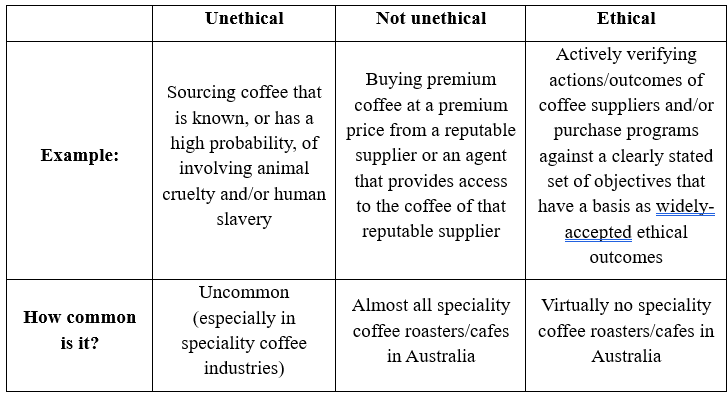
So why is the term ‘ethically-sourced’ bandied about so often?
We think it really comes about from a common misconception in the speciality coffee industry that paying more for quality and ‘building relationships’ with suppliers is ethical. To put it simply, these are not ethical actions. It’s not unethical, and is something that is ‘nice’, but these choices are more aligned with selling the ‘story’ of coffee being sold by a roaster/café.
Knowing the provenance of coffee, and being able to say you know the grower of coffee, sounds ‘nice’. But this is not actually ‘ethical’. It doesn’t pay a coffee organisation to say ‘we source not unethically’. This combined with the fact that there is widespread misunderstanding of what ‘ethical’ means, and no organisation to check up on these claims, results in the term being bandied about by just about every speciality coffee company.
Unfortunately, the lack of understanding and checks and balances in ethical claims seems to directly translate to many companies claiming they ‘ethically source’ coffee without understanding what that means.
Probably, if you asked one such company, they would say something like ‘we seek to ensure we pay above market price for our coffee and work with our suppliers to provide them with security by establishing lasting relationships with them’. This sounds kinda great right? Who wouldn’t want more money and to have a stable supply arrangement? But these claims actions are (generally) not ethical.
Firstly, claims about ‘paying above market’ are often untrue – most speciality coffee sellers actually do pay a ‘market price’ for their coffee, it’s just a higher price than the base commodity market price because the coffee has substantially higher than baseline coffee beans priced on the ‘c market’ (the base commodity market price for coffee that acts as a baseline for essentially all coffee markets). Claims about ‘paying more than X’ should be backed up with clarity around why that approach is being taken, how it generates positive impacts and how adaptation occurs as market price changes.
Secondly, there is growing evidence that high-value agri-food supply chains (including for coffee) involve ‘elite capture’. This means that the elites of a region capture the (vast) majority of benefits in value leaving behind poorer households in the region. In these cases ‘paying more’ is only contributing to increased inequality in source communities and so is probably truly unethical. These cases are most common in smallholder dominated settings (e.g. South East Asia, East Africa) and less common in Latin America where coffee is commonly grown on estates. Though it is also clear that paying more for high quality coffee to wealth landowners in South America is not really ethical. For examples showcasing this research you can see some work in Indonesia (here) or our own, more recent, research on value chain issues in general (here). For a general overview of pitfalls in value chains as development programs see our post on that (here).
At Intersection Traders we operate in-country transacting with many actual coffee-growing households. This is different to most speciality coffee supply chains from Latin America where there are (typically) few suppliers and few buyers. In our case, and for the most part across Africa and South East Asia (but less so in South Asia), coffee supply chains are dominated by many small suppliers. This presents particular complexities, but also opportunities to develop ethical procurement programs. Our approach to pricing for raw coffee supply is based on a ‘market plus plus’ approach - we pay more for the effort needed to harvest quality coffee and to ensure that there remains a premium beyond that when prices are depressed. The conceptual underpinnings of our approach in the ‘crowdy three’ concept note (here) and a range of innovations/pilots supporting growing our impact in the range of posts categorised as ‘Science, Innovation and Evidence’ (see here).
Note: There are several actually really good programs. These do have issues, as essentially all programs do, (e.g. around scaling) but in their location and for their target group seem to be doing really good things.